Consequence Management
Epic Fury, the Architecture India Has Yet to Build & The Price of Dependence

In a suburb of Mumbai, a delivery boy on a motorcycle slows outside a building. He has a single LPG cylinder. There are, by his count, eleven households waiting. He has been doing this long enough to know how the conversation will go.
This is not the image that comes to mind when analysts discuss maritime power projection. It does not appear in briefing slides about strike packages, carrier strike groups, or the degradation of adversary missile infrastructure. Yet it is, in the most direct sense, a consequence of all of those things — a link in a chain that begins with a political decision made in Washington (or was it Tel Aviv) and ends at a kitchen stove in Maharashtra.
Understanding that chain — who bears its weight, who designed it, and who was never consulted about it — is the real lesson of Operation Epic Fury. Not simply that the United States & Israel can strike at scale. It can, and they did. The lesson is what follows.
The US planning failures that is relevant to the ongoing Middle East crisis has been examined in the preceding pieces in this publication Nitividya. What follows examines what that failure cost — not in strategic terms, but in cylinders.
The asymmetry that was always there
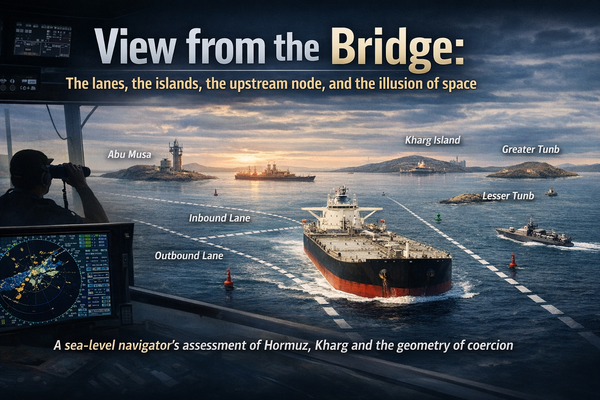
The Strait of Hormuz is twenty-one miles wide at its narrowest point. Through it passes roughly twenty percent of the world’s petroleum liquids — crude oil, condensate, refined products, LNG, LPG — in a daily procession of tankers moving in lanes barely wide enough to permit safe passage in opposite directions.
For the United States, this corridor is a strategic interest. For Asia, it is something closer to a physiological necessity.
The figures are not ambiguous. Eighty-four percent of the crude oil and condensate that transited Hormuz in 2024 was destined for Asian markets. China, India, Japan, and South Korea together accounted for nearly seventy percent of all flows. Japan imports eighty-seven percent of its total energy; ninety-five percent of its crude originates in the Middle East. South Korea channels sixty-eight percent of its crude through the strait.
India, the world’s third-largest crude importer, sources roughly half of its oil from Gulf suppliers whose only seaborne exit is through Hormuz.
The United States, by contrast, is a net energy exporter. It entered this conflict from a position of structural insulation that none of its Asian partners share.
When Operation Epic Fury commenced on the twenty-eighth of February, the asymmetry that had always existed in theory became operational fact. Brent crude surpassed one hundred dollars a barrel on the eighth of March, reaching a peak of one hundred and twenty-six dollars — surging faster than in any prior conflict in the modern era. Tanker traffic, which normally runs at more than one hundred and fifty daily transits, collapsed to between two and thirteen vessels per day. Over three hundred ships anchored outside the strait, insurers withdrew coverage, and international carriers suspended operations.
Washington struck. Asia absorbed.
What consequence looks like from the inside
The aggregate statistics describe a shock. What they do not capture is the texture of consequence as it propagates through a society that had no voice in generating it.
India’s exposure runs on several channels simultaneously, and each channel has its own political and social weight.
Crude oil is the most discussed. India imports eighty-eight percent of its crude needs; roughly half passes through Hormuz. Strategic petroleum reserves and commercial stocks together provide approximately fifty days of buffer — enough to manage a short disruption, but not a sustained one.
LNG is less discussed and more acute. Qatar and the UAE account for fifty-three percent of India’s LNG imports. A closure does not merely raise prices; it disrupts power generation, fertiliser production, and the industrial base that runs on gas-grid supply. The Natural Gas Control Order issued on the ninth of March — invoking the Essential Commodities Act to ration supply across priority tiers — is the bureaucratic expression of a system under stress.
But it is LPG that brings the crisis to the level of the household, and it is LPG that makes plain what consequence management at the national scale actually means in practice.
India imports approximately sixty percent of its LPG consumption. Ninety percent of those imports move through Hormuz. The arithmetic is stark: roughly fifty-four percent of normal LPG availability was directly exposed the moment the corridor closed. And LPG in India is not an industrial input or a fuel for the affluent. It is cooking gas for three hundred and thirty-two million active domestic connections — hundreds of millions of households, many of them added to the gas network under the Pradhan Mantri Ujjwala Yojana, a programme specifically designed to move the rural poor away from firewood and biomass toward clean cooking fuel.
Within days of the closure, the effects were visible at ground level. Weekly LPG inflows fell by an estimated thirty percent. War-risk insurance premiums surged by more than five hundred percent. Daily booking requests surged to 7.6 million by mid-March, against a normal rate of 5.5 million. Queues formed outside distribution centres before dawn. In Delhi, Mumbai, Bengaluru, and Kochi, restaurants closed or cut menus. In Jaipur, a chai vendor with a following built over decades found that the induction top he had acquired in desperation could not replicate the heat and chemistry of a gas flame. In one Mumbai suburb, a delivery boy had one cylinder and eleven households waiting.
The government’s response was competent and swift. The Essential Commodities Act was invoked. Refineries were ordered to maximise LPG yields, diverting propane and butane streams from petrochemical use — boosting domestic production by an estimated twenty-five to thirty percent. Commercial allocations were slashed by up to eighty percent to protect household supply. Over twelve thousand raids were conducted against hoarding and black-market activity. The LPG control mechanism, the diplomatic track with Tehran, the deployment of naval escorts, the emergency sourcing from US Gulf Coast suppliers — these were not the actions of an unprepared state.
They were, however, the actions of a state managing consequences it had not anticipated, for a crisis it had not shaped, through instruments assembled in real time rather than designed in advance. That distinction matters.
The structure of displaced burden
There is a concept in economics called the incidence of a tax: regardless of who nominally pays a levy, the real burden falls on whoever has the least capacity to adjust. The same logic applies to the geopolitics of maritime disruption.
A state that initiates a military campaign in a critical maritime corridor bears the strategic risk of that campaign. The economic consequences, however, are allocated not by the initiating state’s choices but by the structure of global energy dependence. Asia — which has no veto over American strategic decisions, no seat at the NSC table where options were weighed, and no mechanism to register objection before strikes commenced — absorbs the bulk of the economic disruption.
This is not an accident. It is the predictable output of a system in which military power is concentrated in one set of actors and energy dependence is concentrated in another. The United States can project force into the Gulf at scale. It cannot project the consequences of that force back onto itself, because it has, over a generation, systematically reduced its dependence on the corridor through which those consequences travel.
The burden is displaced outward. Countries downstream of American power projection absorb costs they did not incur, manage disruptions they did not choose, and draw down diplomatic capital — with Tehran, with Gulf states, with international institutions — to recover supply lines they did not threaten. India’s four meetings between its External Affairs Minister and Iran’s Foreign Minister since the crisis began are not a sign of strategic alignment with Tehran. They are the price of dependence. They are consequence management conducted at the highest diplomatic level because the alternatives — fuel rationing for three hundred million households — are politically unacceptable.
The question this raises is not about the justice or legality of American action. It is a structural question: as this pattern recurs — and it will recur, because the forces that generated it have not changed — what does it require of states that sit downstream?
What India did — and what it revealed
India’s response to the current crisis has been, by historical standards, a genuine improvement over previous shocks. The diversification of crude sourcing — now spanning forty countries, with seventy percent of imports arriving through non-Hormuz routes compared with fifty-five percent before the crisis — provided real buffer. Strategic reserves bought time. The diplomatic relationship with Iran, preserved through India’s policy of multi-alignment and its studied refusal to take sides in the US-Iran confrontation, produced the access to Iranian goodwill that allowed Indian-flagged vessels to transit while ships from nations that had expelled Iranian ambassadors sat at anchor.
The naval response was also creditable within its limits. Indian warships were deployed to the Gulf of Oman. Destroyers and frigates with MH-60R helicopter coverage escorted the LPG tankers Shivalik and Nanda Devi once they emerged from the Strait of Hormuz and came into open waters. The Jag Laadki, carrying Murban crude, was also provided escort out of the Gulf of Oman under naval protection. At its peak, India has or had over half a dozen warships operating in the region, with twenty-two vessels west of the strait awaiting passage.
These are not trivial achievements. The inter-agency response — Petroleum Ministry, external affairs, the Indian Navy, Oil Marketing Companies, intelligence, and the NSC coordinating across all of them — functioned with a coherence that previous crises did not always demonstrate. India since 2022 has also a National Maritime Security Coordinator (NMSC), a post currently occupied by Vice Admiral Biswajit Dasgupta (Retd), former ENC C‑in‑C, who I would think as a role beyond maritime military security.
But what the response also revealed, with uncomfortable clarity, is the ceiling of improvised consequence management — and how far that ceiling sits below what the situation genuinely required.
The Strategic Petroleum Reserve (SPR) for LPG stood at approximately five days of national demand at the start of the crisis. Even the crude oil reserve, officially rated at 9.5 days, was found by the Comptroller and Auditor General (CAG) in December 2024 to be providing only 4.56 days of import cover — the caverns had been chronically underfilled for years, a finding tabled three months before Epic Fury commenced. The Defence Planning Committee (DPC), constituted in 2018 to connect national security priorities to acquisition planning, met once and produced nothing binding on either reserve policy or naval capability. There is no written National Security Strategy (NSS) that formally identifies sea line of communication protection as a first-order commitment requiring dedicated investment. The institutional architecture for consequence management exists in outline but not in depth.
And then there is the mine warfare problem — which is where the gap between presence and assurance becomes most acute.
Escort without clearance
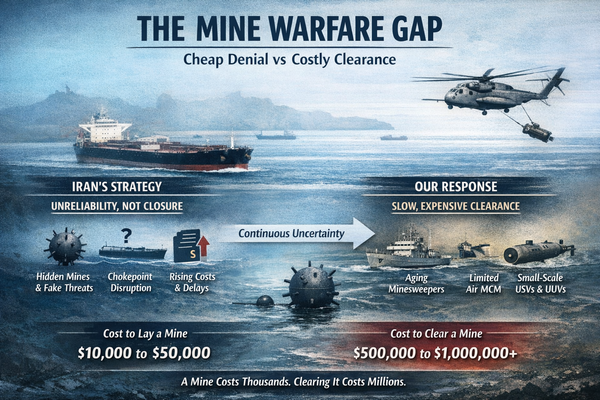
Indian destroyers and frigates are capable ships, manned by professional crews and equipped with modern sensors. What they do not have, as they escort tankers through a strait that American intelligence has assessed as potentially mined, is any organic mine-countermeasures force worth the name. The navy conducting these escorts is operating without a single specialised MCM vessel, relying instead on modular “clip‑on” suites, limited unmanned systems and diver teams—tools that can deal with individual mines but cannot generate the conditions of assured passage that global trade requires.
Assured passage still demands dedicated mine‑countermeasures forces. India, as we read, have indigenous mine‑hunting UUV/AUV systems now entering service, but a fully developed, platform‑based MCM capability—specialised MCMVs operating these systems within coherent doctrine—is still a work in progress rather than an already‑fielded, high‑capacity force.
India’s MCMV effort was conceived in the early 2000s and took shape as a 12‑ship programme at Goa Shipyard in the 2010s, only to be cancelled in 2018 after years of negotiation. The last legacy minesweepers paid off around the same period, leaving the service with no dedicated MCM vessels at all. Since then, replacement plans have cycled through cancelled contracts, corruption inquiries, restarted tenders and shifting requirements, pushing realistic delivery of new MCMVs into the 2030s. As a result, a navy now escorting tankers through a potentially mined environment is doing so without organic, dedicated mine‑countermeasures capability of any kind.
The historical resonance is precise and uncomfortable.
In 1987, when the United States initiated Operation Earnest Will — the convoy escort operation that was the direct predecessor of what is now being improvised in the Gulf of Oman — the first convoy sailed without route clearance despite intelligence warnings about mine threats. The Bridgeton, a reflagged Kuwaiti tanker, struck a mine on the very first transit. Admiral Crowe, Chairman of the Joint Chiefs, halted all convoy operations until sufficient mine countermeasure platforms were deployed. The lesson, absorbed at cost, was categorical: route clearance must precede escort, not follow it.
India is currently running the sequence in reverse. The escorts are operating. The clearance capacity does not exist.
This is not a critique of the Indian Navy, whose officers and sailors are performing with skill under difficult conditions. It is a critique of the institutional process that allowed a twenty-year procurement programme to drift without resolution, in a domain that the current crisis has demonstrated is central to the ability to use contested sea space at all. The DPC that might have prioritised MCMV acquisition met once. The NSS that might have designated Hormuz-dependency as a strategic vulnerability requiring dedicated MCM investment was never written. The consequence is a destroyer operating in a mineable channel without a minesweeper in support.
The companion piece to this essay is planned where I will examine the mine warfare problem in detail — the physics of clearance, the gap between presence and assurance, and what a balanced MCM architecture requires.
The point here is different: the absence of MCM capability is not merely a procurement failure. It is the operational expression of a deeper institutional failure to take consequence management seriously as a planning discipline.
The price of dependence
The phrase Consequence Management entered strategic discourse as a term of art for the management of weapons of mass destruction events — what you do after a nuclear, biological, or chemical incident to limit harm and restore function. It has since migrated into broader usage, covering the full range of activities required to manage the effects of crises that unfold faster than policy can anticipate.
I used the term to wind up the earlier US NSC article. A perceptive reader, Wg Cdr RM Nair, asked me to elaborate on this whole business of Consequence Management at Sea,
What the current crisis makes clear is that consequence management at sea deserves the same institutional seriousness that other domains of crisis management have achieved. It is not a residual activity. It is not what you do after the main event. For countries that sit downstream of major power competition, it is the main event.
The United States will act again. The specific theatre and adversary will differ; the structural logic will not. American power projection generates maritime disruption whose consequences fall disproportionately on Asian economies that were not consulted and cannot opt out. The next iteration may be in the Taiwan Strait, where the exposure profiles of Japan, South Korea, and Taiwan are even more acute than India’s exposure in Hormuz. It may be in the South China Sea. It may be in a corridor that does not yet appear in risk models.
What will not change is the asymmetry: military initiative concentrated in Washington; economic consequence distributed across the states that depend on the sea lanes that conflict disrupts.
For India, the implication is not that American strategic decisions should be deferred to Indian preferences. That is not how power works, and pretending otherwise is not strategy. The implication is that the architecture of consequence management — the reserves, the MCM capacity, the inter-agency coordination, the diplomatic relationships with multiple actors in contested regions, the energy diversification that takes decades and cannot be accelerated in a crisis — must be built in peacetime, as deliberate investment, as the expression of a written strategic framework that names these vulnerabilities and commits resources to addressing them.
An Indian NSC that meets formally around a written NSS with an NSA functioning as an honest broker among principals (including the NMSC) rather than as the sole channel for strategic decision-making, and a DPC that meets more than once, would produce different acquisition priorities, different reserve levels, and different operational capabilities than the architecture that exists today.
The gap between what India has and what the current crisis requires is not primarily a function of resources. India’s defence budget is substantial. It is a function of institutional coherence — of whether the body that is supposed to connect strategic vulnerability to capability investment actually functions as designed.
A note on what this means
In the Mumbai suburb, the delivery boy made his calculation and moved on. The households that did not receive a cylinder that day found other arrangements — induction tops, neighbours, improvised solutions of the kind that Indians are extraordinarily good at producing under pressure. The immediate crisis was managed, as immediate crises usually are.
But consequence management at the national level is not about managing today. It is about ensuring that the next iteration of today — which will come, because the structural forces that produced it have not changed — is absorbed through architecture rather than improvisation.
The real lesson of Epic Fury is not that the United States can project military power at scale into the Persian Gulf. That has been known for decades, and demonstrated repeatedly. The lesson is that the burden of managing what that power sets in motion is increasingly displaced outward — onto states that cannot choose when Washington acts but must absorb the effects when it does.
For those states, consequence management at sea is not optional. It is the price of dependence.
The question is whether that price is paid reactively, in crisis, through improvisation and drawn-down diplomatic capital — or proactively, in peacetime, through the institutional investment that converts vulnerability into managed risk.
India is currently paying the reactive price. The choice about which price to pay in the next crisis belongs to the architecture it builds before that crisis arrives.
The piece that follows in this series — The Mine Warfare Gap: When the Sea Itself Becomes Unreliable — examines the operational dimensions of that absence: the physics of clearance, the legacy of Earnest Will, and what a balanced MCM architecture requires of navies that depend on contested sea space. It is, in a precise sense, the same institutional failure examined through a different lens.