The Mine Warfare Gap
When the Sea Itself Becomes Unreliable

The Quiet Weapon
Late one night in the northern Arabian Sea, a very large crude carrier slows—not because of traffic, weather, or machinery, but because of a report. Somewhere ahead, a radar contact has been flagged: a possible mine, or perhaps something that merely looks like one. The distinction matters less than it should. The ship adjusts speed, the master calls for updates, insurers begin to listen, and somewhere far away, a pricing model quietly shifts.
Nothing has been “closed.” No dramatic blockade has been declared. And yet, something fundamental has changed.
This is how mine warfare works in the 21st century. Not by sealing seas, but by making them unreliable.
The Return of Cheap Denial
Much of the current debate about maritime conflict—whether in the Persian Gulf, the Red Sea, or beyond—remains fixated on visible power: missiles, aircraft, carrier strike groups. These are legible instruments. They are counted, tracked, and displayed.
Mines operate with a different logic.
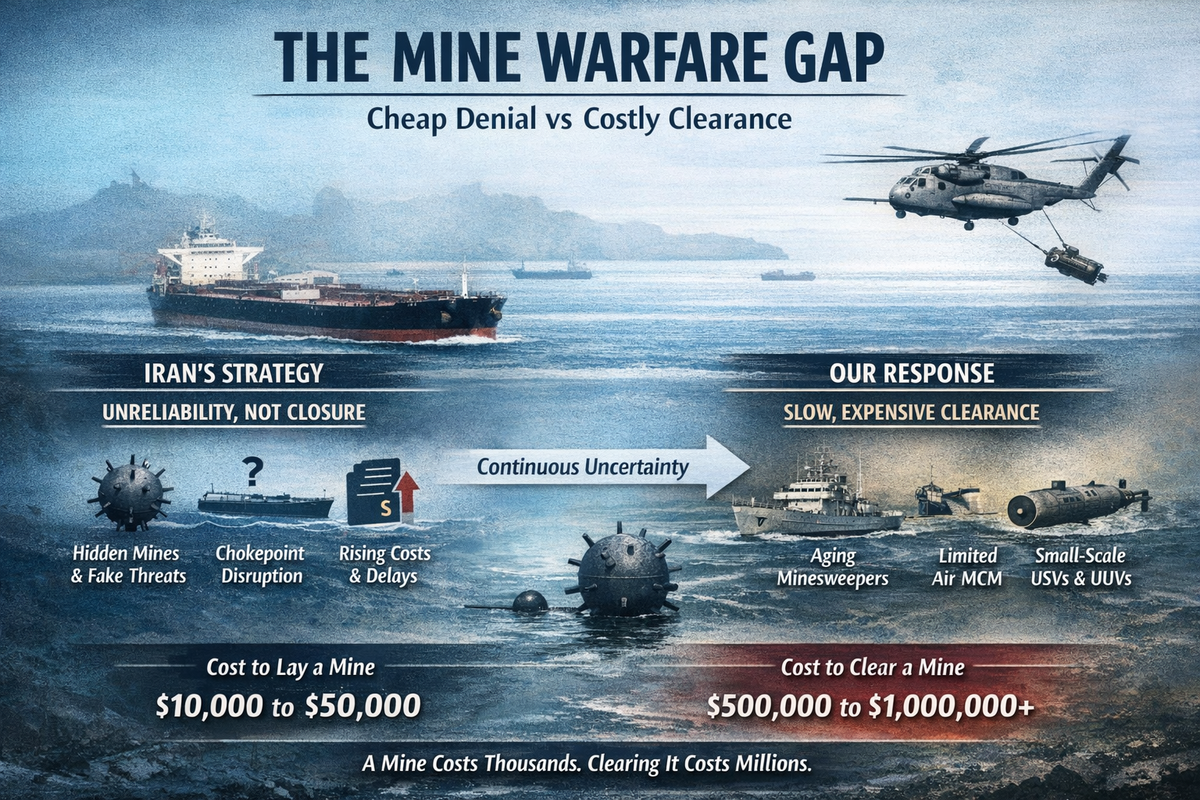
They are cheap, anonymous, and patient. A few hundred, laid with intent and ambiguity, can impose a level of caution out of all proportion to their cost. They do not need to sink ships in numbers to be effective. They need only to introduce doubt—about routes, about timings, about what lies beneath the surface.
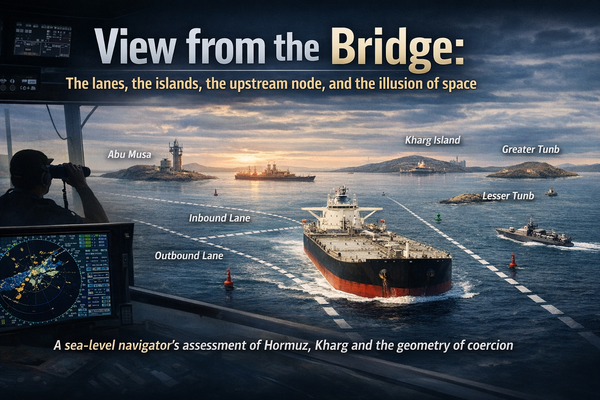
In the Strait of Hormuz, this logic is not theoretical. Geography does much of the work. Traffic is already funnelled into narrow, predictable lanes. Tankers move slowly, heavily laden, with little room to manoeuvre. The introduction of even a limited mine threat does not produce immediate closure; it produces hesitation, rerouting, inspection cycles, and rising insurance premiums. The effect accumulates.
The strategic asymmetry is stark. For the mining state, the objective is not decisive battle but sustained uncertainty. For those who depend on the sea—energy importers, trading economies, naval coalitions—the burden is not to defeat an adversary, but to restore confidence in a space that has become suspect.
And that is a far harder task.
The Neglected Business of Clearing the Sea
Navies understand this in theory. Mine warfare has long been recognised as one of the most difficult and least glamorous aspects of maritime operations. It is slow, methodical, and unforgiving of shortcuts. Clearance demands specialised ships, trained crews, precise sensors, and time—always more time than the situation appears to allow.
Yet over the past two decades, many navies—particularly those most likely to be called upon in a Hormuz-type scenario—have allowed a quiet imbalance to develop.
Dedicated mine countermeasure vessels have been reduced or retired. Airborne mine countermeasure capabilities, once the closest thing to a “fast forward” button in clearance operations, have contracted. In their place has come a promise: that modular systems, unmanned vehicles, and distributed concepts would eventually fill the gap.
The promise is not empty. Unmanned surface and underwater vehicles have made real advances. Sensors are better. Autonomy is improving. But scale and integration remain works in progress. What has emerged, in effect, is a transition without overlap: legacy capabilities drawn down before new ones have matured into reliable, deployable mass.
The result is a gap—not in technology, but in usable capacity.
This matters because mine clearance is not a function that can be surged at will. It cannot be improvised in crisis. It depends on standing forces, practised procedures, and institutional continuity. A navy that has allowed this function to atrophy cannot regenerate it quickly under pressure.
And in a contested chokepoint, time is the one commodity that the system does not have.
Air, Surface, and the Physics of Clearance
Historically, the balance between surface and airborne mine countermeasures reflected a simple reality: physics.
Surface vessels can hunt and neutralise mines with precision, but they do so slowly and in proximity to the threat. Airborne systems—heavy helicopters towing sensors and influence gear—extend reach and speed, allowing larger areas to be swept more quickly. The combination matters. One without the other produces either delay or risk.
The contraction of heavy airborne mine countermeasure platforms has therefore had effects that are not always immediately visible. What is lost is not merely a platform, but a tempo of clearance. In narrow seas where traffic density is high and economic stakes are immediate, that tempo can be decisive.
Some navies have recognised this and acted accordingly. For Japan sea lane security is indeed a matter of life and death.
Japan maintains a dedicated mine warfare force while investing in heavy airborne capability, accepting the cost and complexity that such systems entail. In doing so it departed from the H-60 series standardised across all three Self-Defense Forces and chose the larger AW101-derived MCH-101—a platform that reflects a deliberate institutional choice to treat mine warfare not as an auxiliary function but as a central one.
Others have moved in different directions—towards unmanned systems, towards modularity, towards smaller footprints. These approaches hold promise, particularly in littoral environments. But they also illustrate a broader point: each navy that takes mine warfare seriously chooses a model and commits to it.
The greater risk lies not in choosing imperfectly, but in not choosing at all.
Trump’s Search for a Coalition
When President Trump called on NATO, Japan, and South Korea to contribute forces to Operation Epic Fury, he was not asking allies to improvise. He was asking them to deploy capabilities that, in most cases, they demonstrably possess. But his ask was never precisely, at least publicly, calibrated. Bundled into a generic demand for warships and escort forces, the specific MCM requirement — operationally distinct from presence, not substitutable by it — was never clearly articulated as such. The demand was reactive and tactical rather than rooted in a clear-eyed diagnosis of what specialised threats like mines specifically require. That muddled framing is a planning failure layered on top of a capability failure, and it tells its own story about how seriously the unglamorous business of clearance had been taken at the strategic level before the war began.
The gap between what exists and what has been offered remains, regardless, the most revealing feature of the current crisis — and it maps almost exactly onto the structural argument this piece has been making.
Europe’s position is the sharpest paradox. NATO’s two Standing Mine Countermeasures Groups spent 2025 conducting exercises across the Baltic, Mediterranean, and Atlantic — Baltic MCM, Northern Coasts, Dynamic Move, NUSRET, Sea Breeze — honing precisely the skills now needed in the Gulf. Across the alliance, roughly 150 minesweepers and minehunters are in service, their crews drilled in the procedures that coalition clearance demands. Belgium, Germany, the Netherlands, France, and Italy all maintain meaningful MCM surface forces with genuine institutional continuity. The UK’s Hunt-class and Sandown-class minehunters are purpose-built for the mission. And yet the Royal Navy withdrew its last MCM vessel from Bahrain in early 2026 — HMS Middleton transported home on a heavy-lift ship, unable to make the voyage under its own power — with no replacement positioned before the war began. The Royal Navy’s Mine and Threat Exploration Group has tested autonomous minehunting systems in the Gulf’s warmer waters, and London has gestured at offering these capabilities without committing to do so. The capability exists. The forward presence does not. France and Germany have signalled willingness to contribute, but only after a ceasefire and under a multilateral framework that does not yet exist. The mass is there. The political unlock is not.
South Korea’s case illustrates a different constraint — not political but architectural. Seoul maintains a respectable mine warfare surface force, but its vessels were designed for the littoral environment of the Korean peninsula, not sustained high-threat operations at distance. Korean defence analysts have noted plainly that the minesweepers lack the tolerance, self-defence capability, and logistical reach for the Strait of Hormuz under combat conditions. With 26 ships stranded in the Gulf, Seoul is negotiating passage with Tehran bilaterally — a posture that tells its own story about where its interests have been calculated to lie.
Israel, the kinetic partner in Epic Fury, contributes nothing to the clearance problem. Its contribution is strike — the destruction of Iranian mine-laying assets and naval infrastructure, including the targeting of IRGCN commander Alireza Tangsiri. That matters, but destroying mine-laying vessels is not the same as restoring confidence in the water. Mines already laid could well be dormant and waiting. Israel’s unmanned maritime systems represent genuine innovation in the USV domain, relevant to future MCM concepts. They do not, today, constitute a clearing force.
The United States enters the crisis with its four dedicated Avenger-class ships decommissioned from Bahrain five months before Iran began mining, and two of its three replacement LCS mine warfare vessels were last seen in Malaysian ports weeks into the conflict. The transition without overlap that this piece describes in the abstract is, in the Gulf today, not abstract at all.
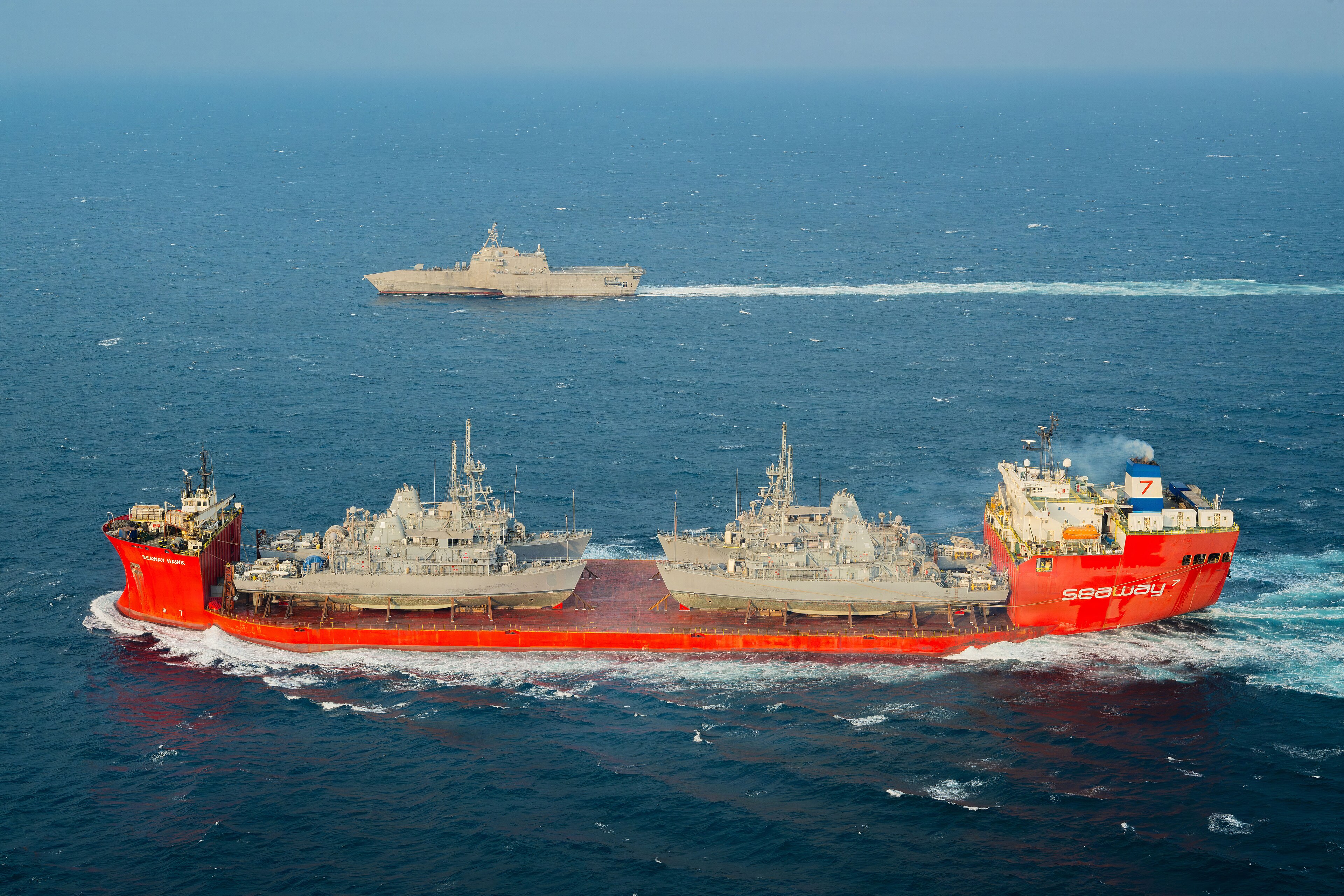
What the coalition ledger reveals is not a shortage of equipment in the world. It is a shortage of equipment that is forward-present, politically available, and operationally integrated in the one place that currently matters. Trump cycled through options in the space of a week — coalition, unilateral action, ultimatum, threat against civilian infrastructure — because none of them addressed the specific operational problem that mine clearance represents. The sea has been made into a question. The nations with the tools to answer it are, for various reasons, not yet answering it. And the leader prosecuting the war did not, in public at least, appear to know precisely which tool he needed to ask for.
India and the Illusion of Technological Sufficiency
For India, the problem is both structural and conceptual.
As a major energy importer with deep dependence on Gulf sea lanes, India sits downstream of precisely the kind of disruption that mine warfare is designed to produce. It is also a navy that has long aspired to the role of a net security provider in the Indian Ocean. And yet, in the specific domain of mine countermeasures, there is a visible thinness.
There are promising developments—particularly in indigenous unmanned systems and sensors. These reflect real technical competence. This argument is not new to this piece. In examining consequence management frameworks for exactly this kind of Gulf disruption, the same gap appeared: indigenous MCM development that is technically credible but institutionally thin, impressive in demonstration but unproven in the sustained operational context that clearance actually demands.
But technology, on its own, does not constitute capability. Capability requires a community: officers and sailors trained in mine warfare, units structured around it, doctrine that integrates it into wider operations, and above all, continuity of practice. Without that, systems risk becoming isolated solutions—impressive in demonstration, uncertain in application. India has nurtured Anti-Submarine Warfare specialists and built platforms and doctrine around them. Mine warfare, by contrast, has been allowed to atrophy: dedicated mine countermeasures vessels have disappeared from the order of battle, and a coherent mine warfare community is not a central institutional focus.
There is also a deeper, more uncomfortable dimension: that of strategic culture.
Opportunities to absorb mine warfare expertise—through partnerships, exchanges, and embedded roles—have not always been fully seized. In one instance, constraints on representation meant that a naval aviator was the only working-level officer that the MOD cleared with a Flag Officer to join staff talks with the French Navy, and then had to plan a mine countermeasures exercise under those restraints. At times, considerations of symbolism, bureaucratic comfort, or alignment have outweighed the practical benefits of immersion in a domain where experience matters enormously. The result is not a dramatic failure, but a gradual absence: of habit, of instinct, of institutional memory.
In a crisis, those absences become visible very quickly.
Presence is Not Assurance
Modern naval discourse often emphasises presence: ships forward deployed, patrols maintained, flags shown. Presence has value. It signals intent, deters opportunism, and reassures partners.
But in a mined environment, presence alone is insufficient.
A warship can transit a threatened area. A convoy can be organised. Escorts can be provided. Yet none of this restores the fundamental condition that commercial shipping requires: trust in the water itself. That trust can only be rebuilt through clearance—through the slow, deliberate process of finding, identifying, and neutralising what lies beneath.
This is where the distinction between visible power and functional assurance becomes stark. A navy optimised for strike and presence may still find itself unable to guarantee the safe passage of commerce if it lacks the means to clear mines at scale and speed.
The implications extend beyond the immediate theatre. Insurance markets react quickly to uncertainty. Freight rates adjust. Routes are reconsidered. The shock propagates through systems that operate on tight margins and even tighter timelines.
In that sense, mine warfare is not merely a naval problem. It is a systemic one.
Designing against Denial
What, then, would a more balanced approach look like?
At its core, it would begin with a simple recognition: that mine warfare is not a niche speciality, but a central function of any navy that depends on the use of constrained sea space. From that recognition flow several design imperatives.
First, persistence. Mine countermeasure forces must be forward present, not held in reserve for crisis. Familiarity with operating areas, patterns of traffic, and local conditions is not something that can be acquired overnight.
Second, mass. Unmanned systems will play an increasing role, but only if they are deployed in numbers sufficient to matter. Demonstrators and prototypes do not clear sea lanes.
Third, speed of clearance. This requires a mix of surface and airborne capabilities, integrated into coherent units that can operate continuously. The physics of the problem has not changed, even if the tools have.
Finally, institutional ownership. Mine warfare must have a community that owns it—doctrinally, operationally, and culturally. The US Navy dismantled its dedicated Mine Warfare Command in 2006, dispersed its units, and entered this crisis still struggling to field a mature replacement. The result has been a hollowing-out of a once coherent community—precisely the trajectory India should avoid.
These are not glamorous requirements. They do not lend themselves to spectacle. But they determine whether the sea can be used when it matters.
The Quiet Contest Beneath the Surface
The prevailing image of maritime conflict remains one of ships and aircraft in motion, of strikes delivered and defences engaged. It is an image shaped by visibility.
Mine warfare belongs to a different kind of contest—one that unfolds slowly, often invisibly, and with effects that are felt more than seen. It is a contest between denial and assurance, between those who seek to introduce uncertainty and those who must remove it.
In that contest, cost favours the denier. Time favours the denier. Initiative, at least initially, favours the denier.
To respond effectively requires more than technology or presence. It requires a deliberate choice to invest in the unglamorous, to maintain capabilities that are rarely used but always needed, and to accept that control of the sea is not secured once, but continuously re-established.
The tanker that slowed in the night will eventually move on. The contact ahead will be investigated, classified, perhaps neutralised. Traffic will resume, though perhaps more cautiously, at greater cost. Nothing will have been “closed.”
And yet, for a time, the sea will have been something else: not a medium of movement, but one with many questions.
How navies answer that question will shape not just the outcome of a crisis, but the credibility of the maritime system on which so much depends.