From Mosul to Hormuz
General Dan Caine, Networked Speed, and the Blur Between Command and Advice

I. Two Wars, One General
“Speed is a decision, not a destiny.”
In December 2018, during a surprise visit to Iraq, President Donald Trump met American commanders directing the final phase of the war against the Islamic State. Since 2014, the US‑led campaign against ISIS had been grinding away at its territorial “caliphate”—through Kobane, Mosul and Raqqa—so that by Trump’s December 2018 visit, the war had already squeezed ISIS into shrinking pockets along the Euphrates.
Coalition aircraft dominated the sky, and the battlefield was saturated with surveillance. Drones, satellites and Special Operations Forces (SOF) produced a near‑continuous picture of enemy movements. Yet despite this technological dominance, the campaign advanced slowly.
During that visit, one officer offered a blunt assessment. If the coalition were allowed to fight differently—if decision cycles were compressed and approvals simplified—“the war could be finished in a week”. The line entered Washington’s bloodstream via Trump himself, who retold it as an example of battlefield confidence. Yet its meaning was more diagnostic than boastful: the coalition already knew how to find and destroy targets; what slowed the war was not the ability to strike, but the time required to decide.
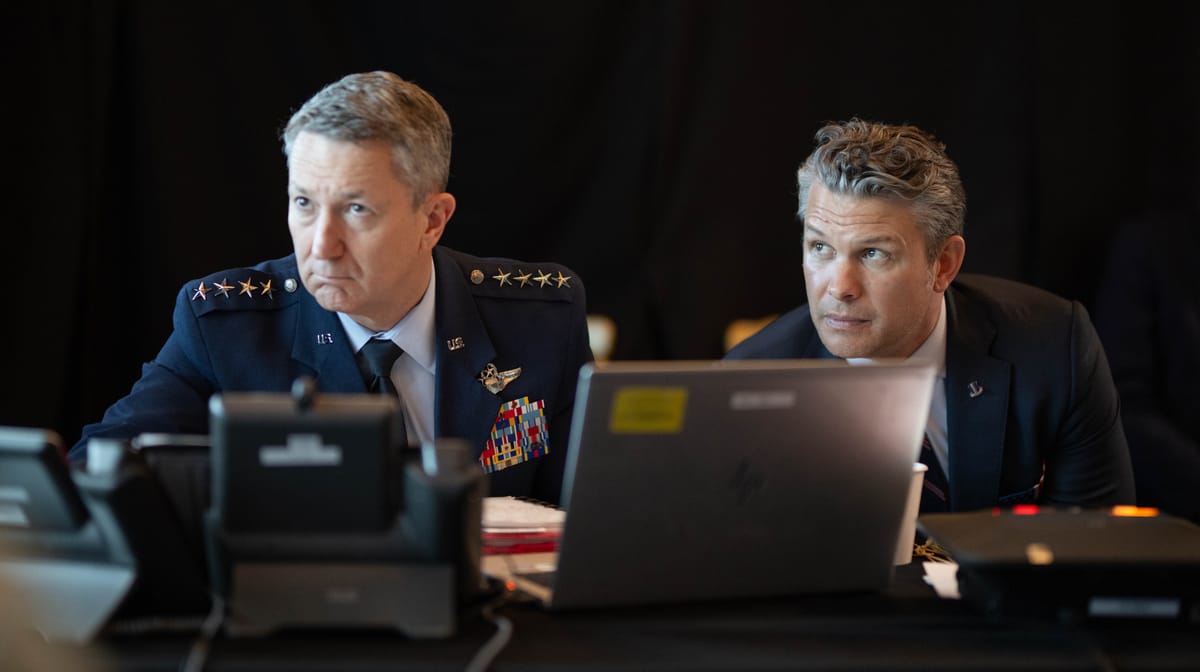
The officer who made that observation was Lieutenant General Dan Caine, then serving as Deputy Commanding General of the Special Operations Joint Task Force directing Operation Inherent Resolve.
Eight years later, the same officer occupies a very different seat. As Chairman of the Joint Chiefs of Staff, General Caine, now a four‑star general, serves as the Principal Military Adviser to the US Commander in Chief, President Donald J. Trump, overseeing all US military operations. That advisory role is being tested most visibly in Operation Epic Fury, the American‑led campaign striking Iranian military targets while attempting to keep open the Strait of Hormuz. The role places him outside the formal operational chain of command, yet at the centre of the system that determines how quickly wars such as Epic Fury are fought. He helped shape the system now in play as a special operations commander in Operation Inherent Resolve, where he first argued that the real constraint on victory was not firepower but the speed of decision‑making.
To the public, he is most visible standing beside Secretary of War Pete Hegseth at Pentagon briefings and, at times, alongside the President himself, explaining how the campaign is being conducted and how its tempo will be managed.
His journey from Mosul to Hormuz, therefore, offers more than a biographical thread. It provides a way to examine how modern networked wars are governed—who is allowed to slow them down, and on what terms. In Iraq, the central question was how much friction civilian leaders should impose on the use of overwhelming surveillance and precision strike against a collapsing insurgency. In the Gulf, the same question now confronts very different institutional systems: a live maritime campaign at the world’s most important energy chokepoint, where the tempo set in Washington can have consequences far beyond the battlefield.
II. Mosul’s Lesson: Technology Can Find. Can Precision Discriminate?
By 2017 and 2018, Operation Inherent Resolve had become a textbook example of modern networked warfare. Coalition forces possessed overwhelming intelligence coverage over the battlefield. Satellites, drones, signals intelligence and special operations teams produced a near‑continuous stream of data. Targets were rarely difficult to identify. ISIS fighters, vehicles and command posts were quickly detected once they moved or communicated.
The technological side of the kill chain functioned efficiently. Sensors detected activity. Intelligence analysts fused the information. Aircraft and artillery were available to strike.
Yet, operations moved more slowly than that architecture might suggest. Each potential strike passed through multiple layers of review. Civilian‑casualty assessments, coalition coordination requirements and higher‑headquarters approvals introduced deliberate delay into the process. These delays were not technological failures but political and legal safeguards designed to limit civilian harm and preserve coalition legitimacy.
The lesson many officers drew from Iraq was therefore simple: the challenge of modern war was no longer technological but procedural. In the post‑9/11 battlespaces, the problem was no longer how to find or how to finish; it was the slow, contested procedural space in between—fixing a target, classifying it, and getting permission to strike.
General Caine’s background positioned him squarely within this emerging style of warfare. A career F‑16 pilot-instructor and graduate of the USAF Weapons School, with extensive operational experience in Iraq and Afghanistan, he operated within the ISR–SOF–airpower ecosystem that defined post‑9/11 American campaigns. In these wars, small teams on the ground and large sensor networks in the air combined to create a battlespace in which detection and precision strike were routine.
From finding targets to deciding when not to strike.
Victory, therefore, depended less on technological innovation than on the willingness of political leaders to shorten the decision cycle between detection and action.
III. An Unusual Chairman
General Caine’s rise to the chairmanship of the Joint Chiefs was, therefore, unusual even by Washington standards.
His appointment broke several longstanding patterns in American military leadership. He became the first chairman drawn from the National Guard or reserve component, the first appointed directly from retirement, and the first to reach the position without previously serving as a four‑star officer or holding the traditional feeder posts such as service chief or combatant commander.
The legal pathway for such an appointment existed but was rarely used. US law sets experience requirements for the Chairman of the Joint Chiefs, but it also allows the President to waive them in the national interest. In this case, the waiver was invoked explicitly.
Following Senate confirmation, General Caine returned to active duty and was promoted to four‑star rank shortly before assuming office. The vote approving him passed the Senate by a substantial majority, though not without controversy, as critics questioned whether the appointment weakened the professional norms that typically govern the selection of senior military officers.
Seen from a broader institutional perspective, the decision represented a deliberate departure from the career pathway created after the Goldwater–Nichols reforms of the 1980s. That system was designed to produce senior officers experienced in managing large joint institutions and navigating complex bureaucratic environments.
General Caine represented a different archetype: an operator shaped by the tempo of network‑centric warfare rather than by decades of joint bureaucratic leadership.
That choice matters now because the campaign unfolding over Hormuz is precisely the kind of networked, decision‑speed‑dependent war for which he was selected.
IV. The Janowitz Problem
The sociologist Morris Janowitz once described the officer corps as a semi‑autonomous profession, governed by internal norms and promotion filters that help insulate military advice from purely political pressures. Under that model, senior commanders emerge through a corporate selection process that rewards institutional experience, professional reputation and adherence to established norms.
General Caine’s career path complicates that model. His long association with the Air National Guard meant that parts of his career unfolded outside the full‑time active‑duty hierarchy. At various points, he combined military service with civilian business roles and work within the broader intelligence community. His elevation to the chairmanship, therefore, depended less on the traditional corporate ladder than on a presidential waiver that bypassed several of its stages.
From a Janowitz perspective, three implications follow.
First, the social base of senior leadership becomes more ambiguous. Reserve officers often maintain strong connections with civilian institutions and regional networks outside the military establishment.
Second, bypassing the usual promotion sequence weakens the internal filtering mechanisms through which the officer corps normally selects its senior leaders.
Third, the symbolic meaning of the appointment shifts. Instead of representing restraint, the first reserve‑component chairman now oversees a period of intense expeditionary military activity.
In practice, the regular promotion ladder is meant to rest on sound professional military education and grounding. The Reserve Officer track, by contrast, tends to accept a more compressed, part‑time version of that education. Against that backdrop, the system has elevated a Chairman, Joint Chiefs of Staff, whose signature promise was faster wars rather than capstone grounding.
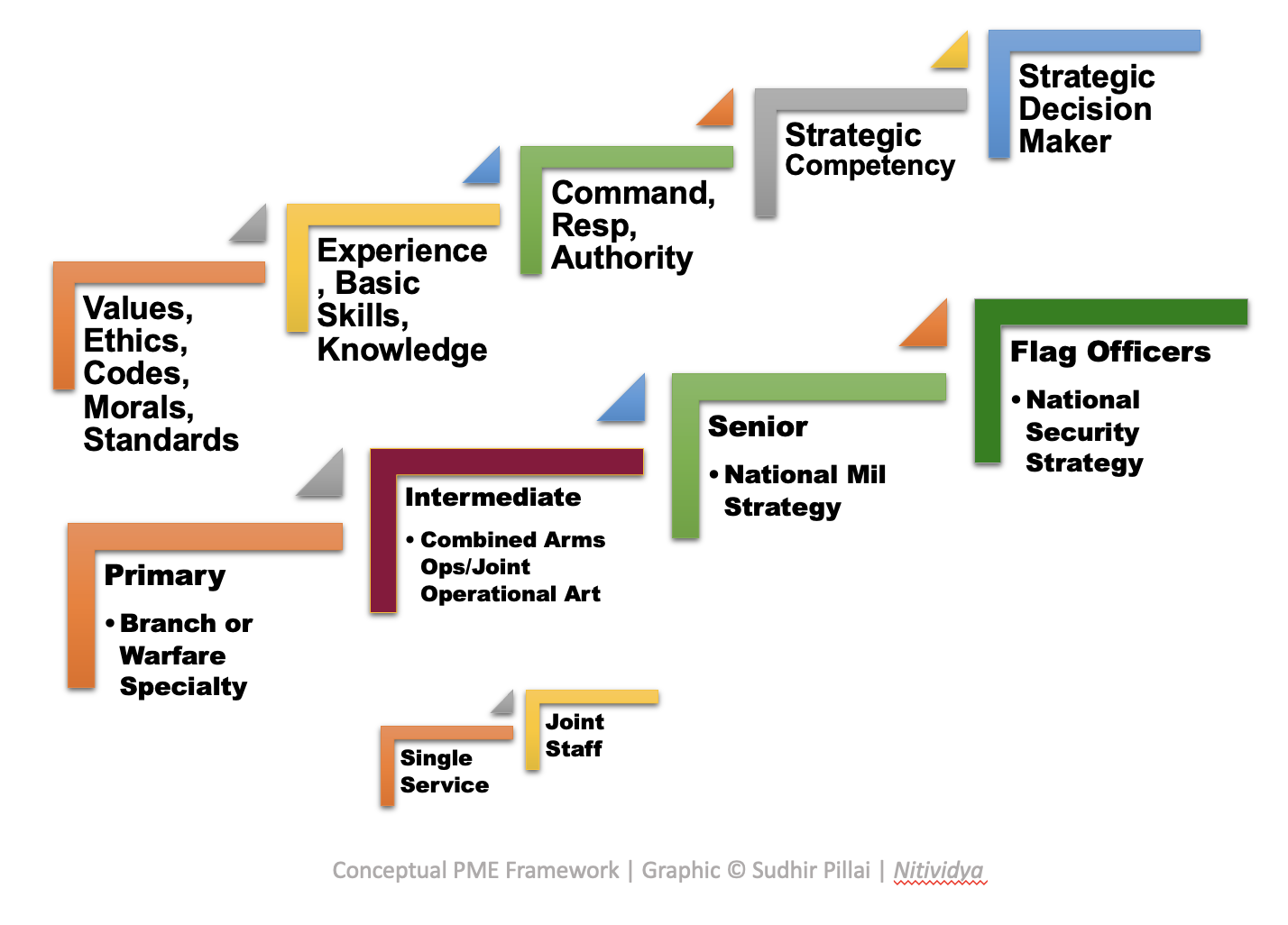
The typical solid, residential grounding would treat war and armed conflict through Clausewitzian or Corbettian strategic lenses, and operations in the Tukhachevskian sense of deep, systemic campaigns. Instead, his key intermediate‑level professional military education was done by correspondence rather than through the standard residential staff‑college route. His post‑promotion stint in CAPSTONE – the short joint course the U.S. runs for new generals and admirals – and his time at Harvard were brief senior‑leader or executive‑education programs, not a full war‑college education.
On a Janowitzian reading, the puzzle is straightforward: a reserve system designed to produce politically disciplined, constabulary‑minded ‘citizen‑soldiers’ has thrown up a Chairman on the promise of faster, more decisive wars.
V. Epic Fury: Network War Goes to Sea
Operation Epic Fury represents the most recent test of this operational philosophy.
The campaign began with a series of coordinated strikes against Iranian missile sites, naval facilities and infrastructure linked to the Islamic Revolutionary Guard Corps. The stated objective was to degrade Iran’s ability to threaten international shipping and to ensure continued access to the Strait of Hormuz, through which roughly one‑fifth of global oil supplies transit.
Operationally, the campaign relies on the same networked architecture that characterised earlier American wars. Space‑based sensors, drones, naval aircraft and Intelligence, Surveillance & Reconnaissance (ISR) platforms feed continuous data into joint targeting cells. From there, strikes are directed using aircraft, missiles and other precision weapons.
In structural terms, Epic Fury resembles the operational model refined during the wars in Iraq and Syria. The difference lies in the environment.
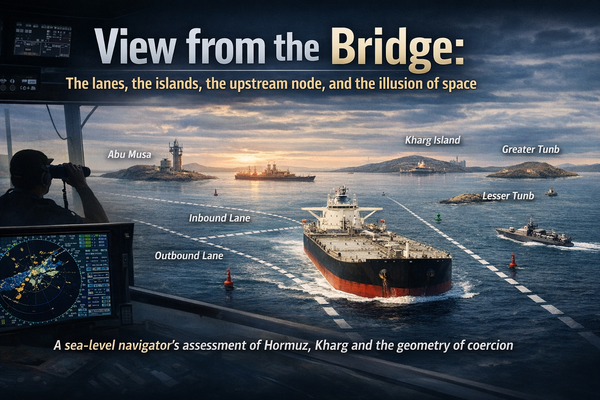
The Strait of Hormuz is not an isolated battlefield. It is the world’s most densely contested maritime chokepoint. Iranian naval forces—including the IRGC Navy—operate alongside conventional naval units, commercial shipping and the forces of several regional and international powers.
This density creates a very different strategic context for rapid targeting cycles. In Iraq, accelerating the kill chain primarily increased the risk of civilian casualties near ISIS positions. In Hormuz, misidentification or excessive escalation can disrupt global energy flows or provoke retaliation from multiple actors—and, as the strike on the Minab girls’ school has shown, a single error can kill scores of children and trigger international outrage. In debates over lethal autonomous weapon systems, we ask who is responsible and accountable when an algorithm pulls the trigger; Epic Fury poses a parallel question for networked human systems: when the kill chain is this fast, who is actually empowered to say no?
That incident is now under investigation in Washington precisely because it raises a crucial question: when the network makes it possible to strike quickly, who within the system is responsible for insisting that some targets and some risks require the war to move more slowly?
Yet the campaign’s public presentation emphasises speed and decisiveness. Officials describe Epic Fury as a limited operation measured in weeks rather than months, enabled by high confidence in precision weapons, real‑time intelligence and rapid-fire targeting.
The same doctrinal instinct that sought to compress decision cycles in Mosul now operates in a maritime system far more sensitive to miscalculation.
This invites uncomfortable questions. How many layers of review have been removed in order to sustain Epic Fury’s pace? Who, within the system, is empowered to say that a particular target set should wait for more intelligence, for diplomatic signalling, for alliance consultation—rather than be struck simply because the network can find it?
“In Epic Fury, what matters more than the vulnerability of carriers is the way a networked war in a chokepoint is governed: who decides how fast the kill chain runs, and how much friction is left in the system.”
VI. Advice, Command and Tempo
Under American law, the chairman of the Joint Chiefs of Staff is not part of the operational chain of command. That authority flows from the President to the Secretary of Defence (now Secretary of War) and then to the combatant commanders responsible for specific regions.
The Chairman’s role is formally advisory. He provides military advice but does not command forces in the field.
In practice, however, the distinction can become less clear during high‑tempo operations—especially when the chairman is someone like General Caine, whose operational identity is bound up with managing tempo.
The Chairman often becomes the public face of the campaign, explaining objectives, phases and operational progress alongside civilian leaders. During Epic Fury briefings, General Caine has frequently occupied this role, describing the campaign’s rhythm and emphasising the ability to maintain operational pressure while avoiding escalation.
In a networked war, the decisive authority is not always the officer who signs the strike order. It may instead be the person who determines how quickly those orders must move through the system. When the senior military adviser publicly endorses a particular operational tempo, he is no longer merely describing the machine; he is, in effect, helping to set the speed at which it runs.
In law and ethics alike, responsibility does not rest only with the person who signs a particular order; it also attaches to those who design and maintain the decision structures that make certain kinds of orders more likely, or harder to resist.
VII. Narrow Seas, Networked Speed
Maritime chokepoints have always compressed the distance between tactical events and strategic consequences. Operation Epic Fury, conducted in the same kind of narrow sea and restricted spaces, shows how little room for error remains once time and space are compressed.
Sensors detect activity instantly. Information moves through command systems in seconds. Precision weapons can strike targets across the battlespace almost immediately. Geography still constrains movement in narrow seas. Networked warfare now compresses time as well.
The General Caine story suggests a different lens. In Epic Fury, what matters more than the vulnerability of carriers is the way a networked war in a chokepoint is governed: who decides how fast the kill chain runs, how much friction is left in the system, and how much risk of escalation civilian leaders are prepared to accept.
VIII. Culture, Committees and Control
Like many fighter pilots shaped by Boyd’s OODA‑loop mentality, General Caine’s professional instinct is to treat speed itself as an advantage—to operate inside the enemy’s decision cycle and to see hesitation as a kind of defeat. It is no coincidence that the sharpest public critique of Hormuz as a “humiliation” for surface fleets has come from an Indian Air Marshal: fast‑air cultures in both militaries, schooled in the same OODA‑loop logic, are inclined to read narrow seas through the lens of missile envelopes, sensor ranges and reaction time. In a networked chokepoint war, those instincts need to be balanced by institutions that still know how and when to slow the fight down.
On paper, Operation Epic Fury is surrounded by checks and balances. The National Security Council, congressional leaders, the Joint Chiefs and the combatant commander all sit inside a system designed to diffuse responsibility and force collective scrutiny of major decisions. Yet politics shapes how that system actually works. Secretary of War Pete Hegseth has publicly told senior officers that the “era of politically correct leadership” is over and urged those who disagree with the new direction to “resign or be fired”—a “my way or the highway” ultimatum that hangs over every discussion of rules of engagement and operational risk. In such an environment, formal committees exist, but the space for dissent within them narrows.
That context matters for how we read General Caine’s role. When a Chairman with a fighter pilot’s penchant for speed sits beside a Secretary of War who warns generals not to get in the way of the president’s chosen course, “advice” can easily slide into justification.
When a Chairman with a fighter pilot’s penchant for speed sits beside a Secretary of War who tells generals ‘my way or the highway’, advice can easily slide into justification.
Conclusion
General Caine’s journey from the battlefields of Iraq to the maritime crisis unfolding in the Strait of Hormuz reflects the broader transformation of modern warfare. Networked military systems have made detection and precision strike routine. The remaining question is how quickly political leaders are willing to authorise their use.
In Mosul, the answer shaped the pace of a campaign against a collapsing insurgency.
In Hormuz, the same question unfolds amid fragile energy markets and the world’s most important maritime chokepoint.
Operation Epic Fury is the first major war in which that trade‑off between networked speed and stabilising delay is being managed by an officer whose entire career taught him that delay is the enemy. Now, as Chairman, there appears to be an insistence on ‘going faster’. His elevation follows a non‑traditional Commander‑in‑Chief who wants exactly that kind of instinct at the heart of his national‑security team.
The story of General Caine is not simply the rise of one general. It is a warning about what happens when the most powerful military system ever built begins to treat delay as the only unforgivable sin.
If Epic Fury is a stress test of how a highly centralised US system handles networked speed under a president who prizes rapid action, India faces the opposite risk: drifting into joint, all‑domain warfare with command and authority still muddied by rank symbolism and half‑finished theaterisation reforms. See: ‘Theaterisation reform is stuck on ranks and roles — India’s military needs clarity’ (ThePrint).