Part III – Theory of Victory and the Escalation Ladder
Theory of Victory, Escalation Ladders, and End States in the US–Israel–Iran War

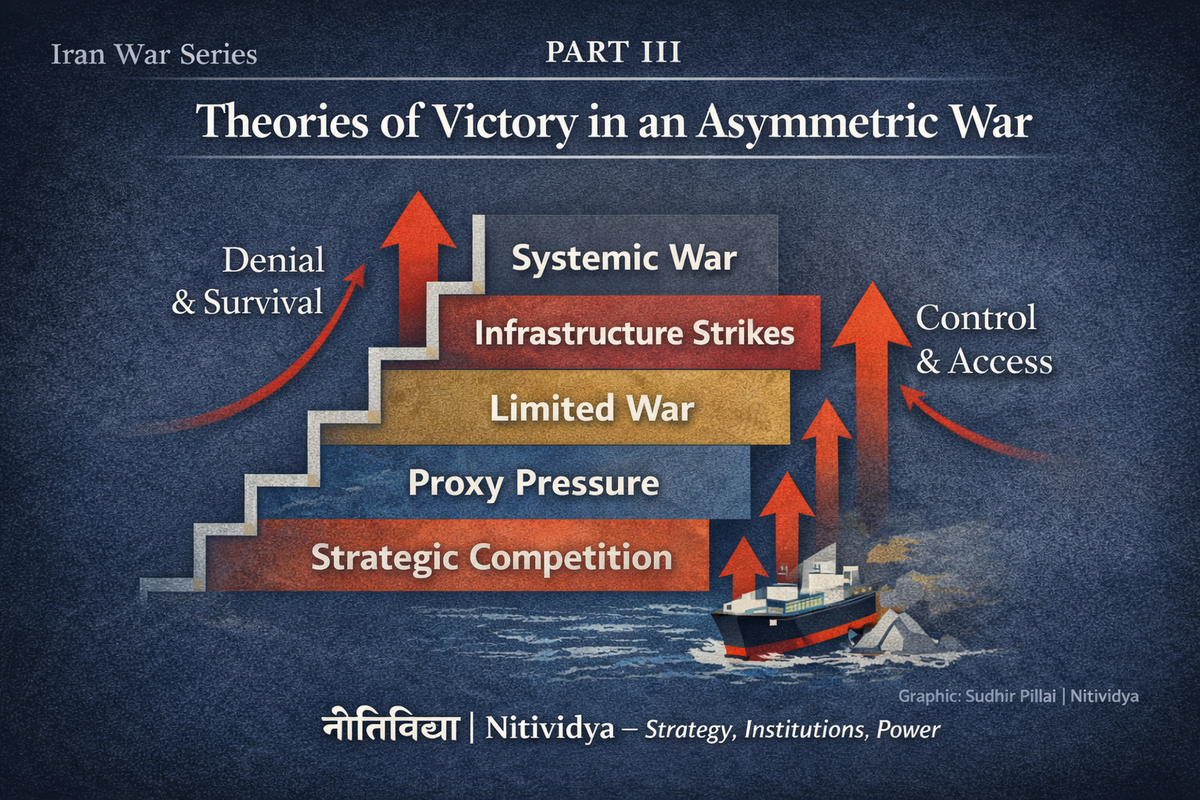
In the first part of this series, I argued that the US–Israel–Iran confrontation is best understood not simply as a cycle of aggression and response, but as a security–insecurity spiral.
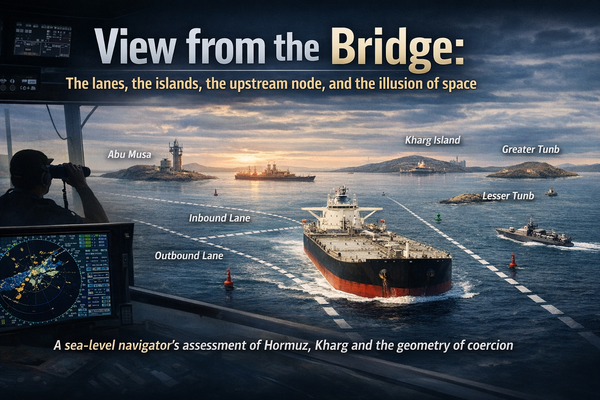
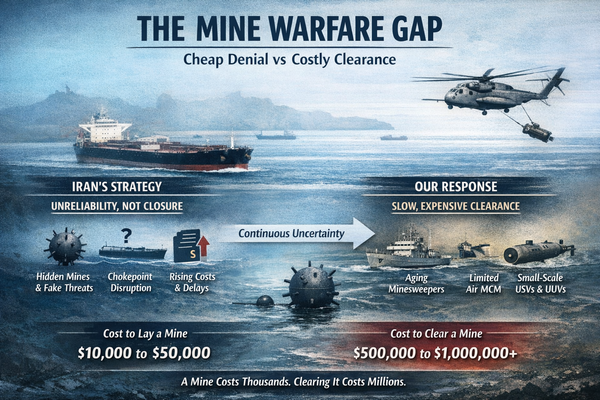
In the second part, I shifted to the maritime theatre and argued that the Strait of Hormuz is where this spiral is most economically and strategically acute. There, Iran’s denial strategy need not defeat a stronger navy in battle. It only needs to make the use of the sea costly, uncertain, and politically fraught.
That brings us to the deeper question: What, in such a conflict, does victory actually mean?
The answer is less obvious than it first appears, because the opposing sides are not trying to achieve the same kind of victory. The stronger coalition seeks to restore order, maintain access, and reassure allies. The weaker power seeks to deny, survive, and retain leverage. One side thinks in terms of control; the other thinks in terms of endurance.
That asymmetry matters. It means the war can be militarily inconclusive and yet politically meaningful. It also means that the same outcome can be narrated as success by both sides.
To see how, we need to look first at the escalation ladder on which both are fighting, and then at the very different theories of victory they bring to it.
The escalation ladder
Before we can answer what victory actually means in such a conflict, we must first understand the escalatory structure on which both sides are operating.
Herman Kahn’s famous insight was that escalation is not best understood as a smooth slide from peace to catastrophe. It proceeds in rungs, each with its own signalling logic, political meaning, and risk of further movement.
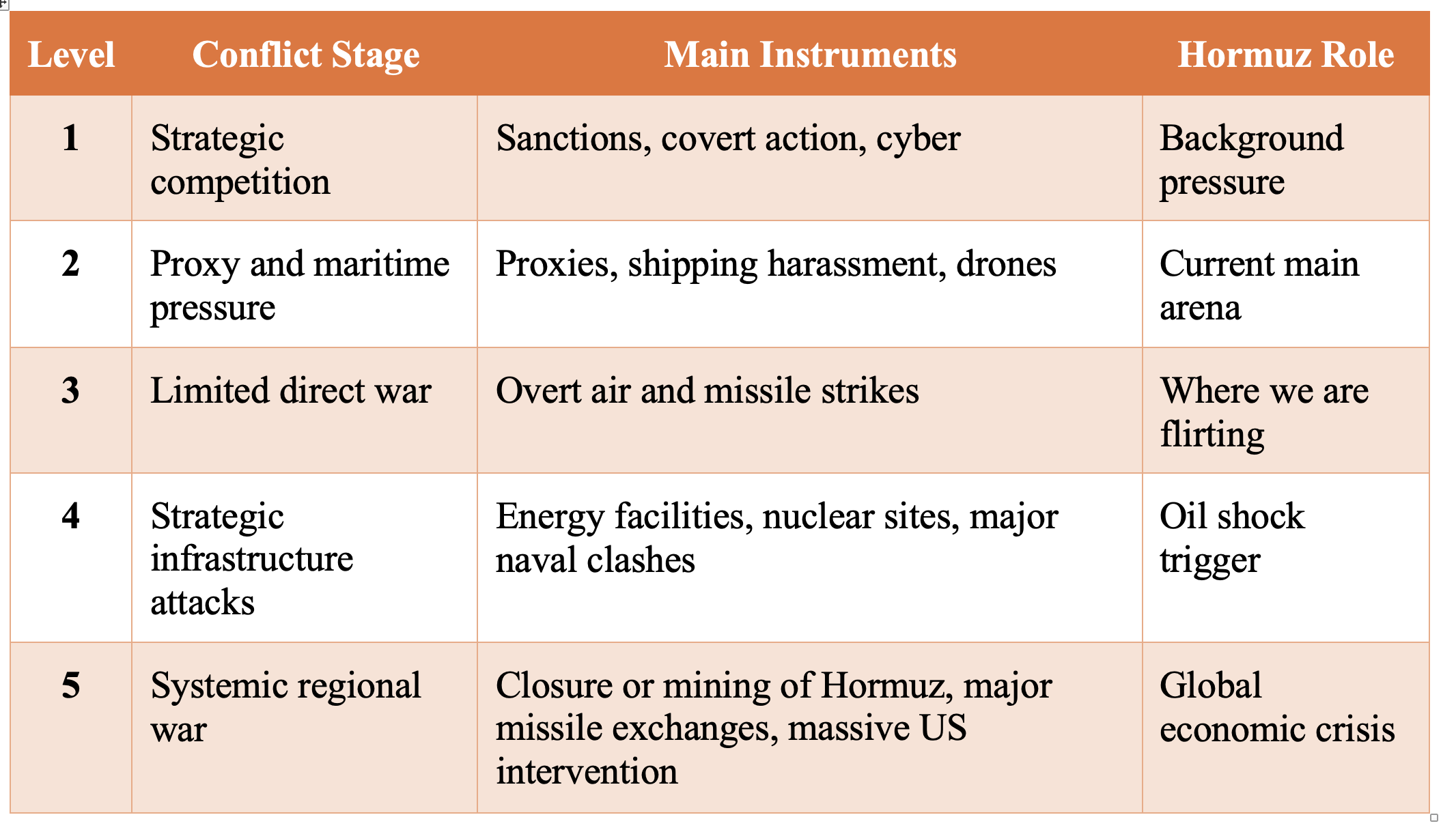
The value of such a ladder lies not in prediction but in analytical discipline. It reminds us that every “limited” move occupies a rung from which movement upward remains possible.
At present, the conflict appears to fluctuate primarily between Levels 2 and 3. Proxy attacks, maritime harassment, drone strikes and selective targeting of military assets belong to this band. Both sides are trying to use these rungs coercively without tumbling into Level 4.
The most sensitive hinge in that transition is the Strait of Hormuz.
A large-scale mining campaign, a mass-casualty naval incident, a sustained interruption to tanker traffic, or a major strike on energy infrastructure would move the conflict beyond controlled signalling into systemic economic shock. At that point, a regional confrontation would become a global crisis.
Hormuz matters because it sits exactly at the point where tactical acts can have strategic, even macroeconomic, consequences. That brings us to the deeper question: what does victory actually mean in such a conflict?
Why victory looks different in asymmetric wars
A theory of victory is the causal logic that links military means and methods to an acceptable political end-state. It is the answer a state gives, implicitly or explicitly, to a basic question: how exactly will what we are doing produce an outcome we can live with?
In symmetric wars, the answer may appear straightforward: defeat the opposing army, seize territory, impose terms. In asymmetric conflicts, the logic is different. The sides seek different outcomes and measure success by different standards. The stronger side often seeks restoration, suppression and predictability. The weaker side seeks to avoid defeat, impose cost and keep options alive.
That difference can be set out simply:
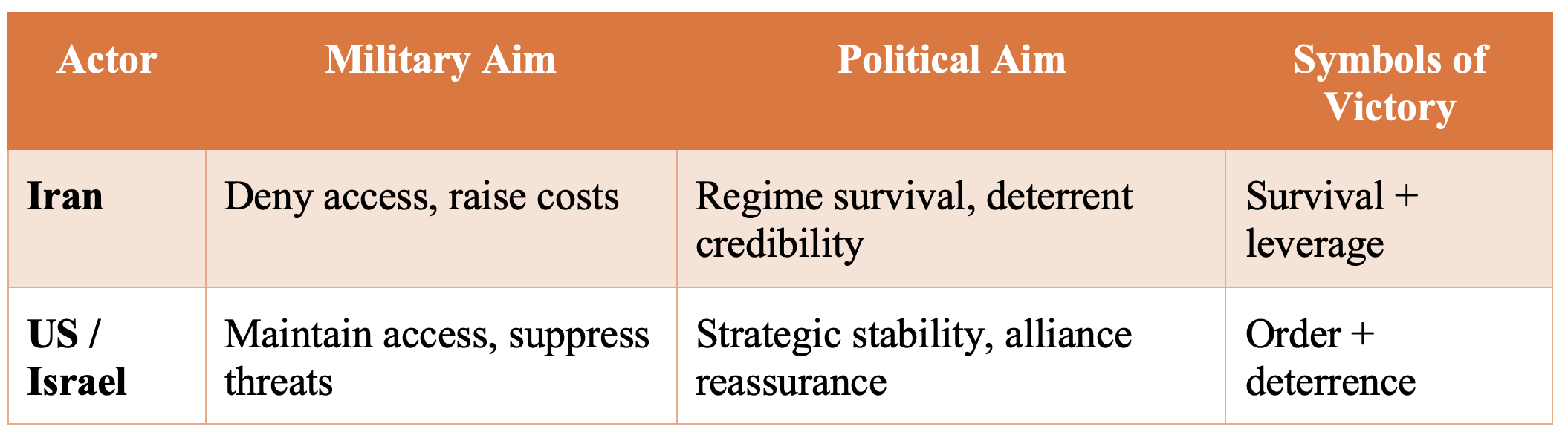
This is why asymmetric wars so often look strange to outside observers. A conflict may appear indecisive in purely military terms, yet still allow every actor to claim some version of success. The stronger side points to continued access and the restoration of deterrence. The weaker side points to survival and the fact that the stronger power did not achieve its maximal aims.
In asymmetric war, victory is rarely a shared metric. One side asks, “Did we restore order?” The other asks, “Did we survive and remain dangerous?”
That distinction is central to understanding the present confrontation.
Iran’s theory of victory: survive, deny, outlast
Iran’s theory of victory is not built around conquest, nor on the fantasy of defeating the United States or Israel in conventional battle. Its logic is more austere and, in strategic terms, more realistic.
At its core lies endurance.
Iran needs to survive attacks, preserve enough capability to inflict pain, and stretch the political and economic tolerance of its adversaries. It does not need to win a clean battlefield decision. It needs to prevent the emergence of an end-state in which the regime is overthrown, its deterrent credibility shattered, and its ability to threaten retaliation removed.
This is consistent with the pattern of Iran’s long-running shadow war. Tehran has repeatedly relied on layered defence, strategic depth through proxies, missile forces, nuclear latency, and maritime leverage. Its aim has been to complicate adversary planning and raise the price of coercion.
The maritime dimension fits neatly within this logic. In and around the Strait of Hormuz, Iran seeks to transform geography into a source of bargaining power. It cannot dominate the Gulf in blue-water terms. But it can threaten the smooth flow of energy and create recurring uncertainty in shipping and insurance markets. Even intermittent harassment can trigger price spikes, disrupt freight scheduling and remind importers that Gulf stability remains contingent.
In this sense, Iran’s strategy is not merely military. It is also economic and psychological.
The key is not permanent closure. It is recurring risk.
That is where maritime insurance becomes strategically important. As discussed in Part II, relatively small acts of violence can have disproportionately large commercial effects when insurers, reinsurers and shipowners reassess their exposure. A single damaged tanker, a few missile alerts, or a cluster of delayed sailings may do more to affect behaviour than any dramatic naval engagement.
Iran’s logic is therefore cumulative. Harassment at sea, distributed escalation through proxies, and calibrated ambiguity are all meant to raise the cost of continued pressure without crossing thresholds that would trigger an all-out campaign aimed at regime destruction.
Its use of proxies serves the same end. By distributing escalation across multiple theatres, from the Levant to Iraq to Yemen, Tehran ensures that the battlefield remains broad, layered and politically untidy. It also preserves degrees of deniability and flexibility. Limited strikes and pressure operations can be dialled up or down without committing Iran to a single decisive confrontation.
Iran, in short, “wins” if three conditions hold: the regime survives, its adversaries stop short of total war, and it retains enough retaliatory capacity that its deterrent remains credible.
That is not glamorous. But it is coherent.
US–Israel theory of victory: restore order and access
The US–Israel theory of victory rests on a different strategic logic.
It is not, in the present context, primarily about occupying Iran or destroying every element of its military power. Rather, it is about restoring freedom of action, reducing the disruptive capacity of Iranian tools, and reassuring allies and markets that the regional order remains broadly governable.
It is a theory of victory centred on control rather than conquest.
At sea, that means maintaining navigational access, escorting shipping as necessary, and suppressing or deterring the assets that destabilise the Gulf. In the air and on land, it means degrading missile launchers, drone infrastructure, command nodes and other enabling systems. Politically, it means reinforcing the belief that Iran can harass but not fundamentally alter the regional balance.
Several mechanisms follow from this.
First, there is the direct degradation of capabilities: missile sites, drones, naval infrastructure, logistical nodes and intelligence networks. Second, there is deterrent signalling through selective but visible strikes. Third, there is reassurance: the need to convince Gulf partners, Asian importers, European allies and energy markets that the United States and Israel can keep disruption within manageable bounds.
For Washington in particular, the audience is not only Tehran. It is also Riyadh, Abu Dhabi, Tokyo, Seoul, New Delhi, and the global insurance and shipping communities that interpret military risk in commercial terms. A great power that cannot reassure maritime markets faces a credibility problem that exceeds the immediate battlefield.
For Israel, the aim is similarly practical. It seeks to ensure that Iran’s forward and retaliatory capabilities are constrained to the point that the immediate threat environment remains tolerable. It does not need to eliminate Iran from the map. It needs to preserve the strategic proposition that Iranian escalation can be punished, contained and deterred.
The coalition, therefore, “wins” if maritime trade continues broadly normally, if Iranian harassment becomes a manageable and increasingly ineffective background condition, and if regional deterrence is visibly restored.
Iran seeks leverage through survival. The US and Israel seek stability through suppression. Both can claim success without either achieving a decisive military finish.
Why asymmetric wars produce competing victories
This difference in theory of victory explains why such conflicts so often drag on.
Each side uses a different yardstick. Iran asks whether it has survived and preserved its capacity for threat. The US–Israel coalition asks whether it has maintained access and restored confidence. Those are not the same metrics. Nor are they mutually exclusive.
That is why asymmetric wars frequently become wars of endurance. The weaker side tries to widen the battlefield, extend the timeline and shift some of the burden onto economics, psychology and political patience. The stronger side tries to compress the conflict, compartmentalise it, and prevent disruption from becoming systemic.
Misaligned expectations create danger here. If the United States or Israel expects Iran eventually to capitulate under pressure, while Iran only expects to survive and stay dangerous, both sides may misread the point at which the other is prepared to stop. The same applies in reverse. If Tehran assumes that all opponents are indefinitely casualty-averse or unwilling to escalate, it may overplay ambiguity and stumble into a harder response than anticipated.
This is where escalation analysis becomes useful. A theory of victory does not exist in the abstract. It operates within a ladder of possible moves, thresholds and consequences.
Three plausible end states
Conflicts of this kind rarely end with neat surrender documents or clear battlefield conclusions. More often, they settle into one of a small number of broad equilibria.
Three plausible end states stand out.
1. Managed deterrence restoration
This is the most likely outcome.
In such a scenario, limited strikes gradually taper, shipping resumes under heavy escort and risk management, and insurers reopen cover, albeit at higher premiums. Iran retains its regime and much of its proxy architecture. The US and Israel demonstrate that they can strike back and impose costs. Neither side gets everything it wants, but both can present the outcome as vindication of their strategy.
This is, in effect, a tense stalemate narrated as success by all parties.
2. Iranian strategic breakout
A second possibility is that sustained pressure pushes Iran toward overt nuclear breakout or an unmistakable threshold posture. This would transform the region's deterrence structure. Paradoxically, the immediate risk of all-out war might decline once a clearer nuclear balance emerges, but chronic low-level instability would likely persist or deepen.
The region would then move into a more explicit form of the stability–instability paradox (Snyder): a theory developed to explain nuclear deterrence during the Cold War that suggests that strategic stability at the level of catastrophic war can encourage greater risk-taking at lower levels of conflict.
3. Regional escalation and strategic shock
The third possibility is less likely but far more dangerous. This is the scenario in which closure or heavy mining of Hormuz, major US naval losses, sustained attacks on energy facilities, or large-scale strikes on nuclear infrastructure push the conflict into systemic war.
The consequences would be severe: prolonged energy shock, inflation, supply disruption, fiscal stress for importers, political turbulence across the Gulf, and wider instability and global recession affecting Europe and Asia alike.
These possibilities can be summarised simply:
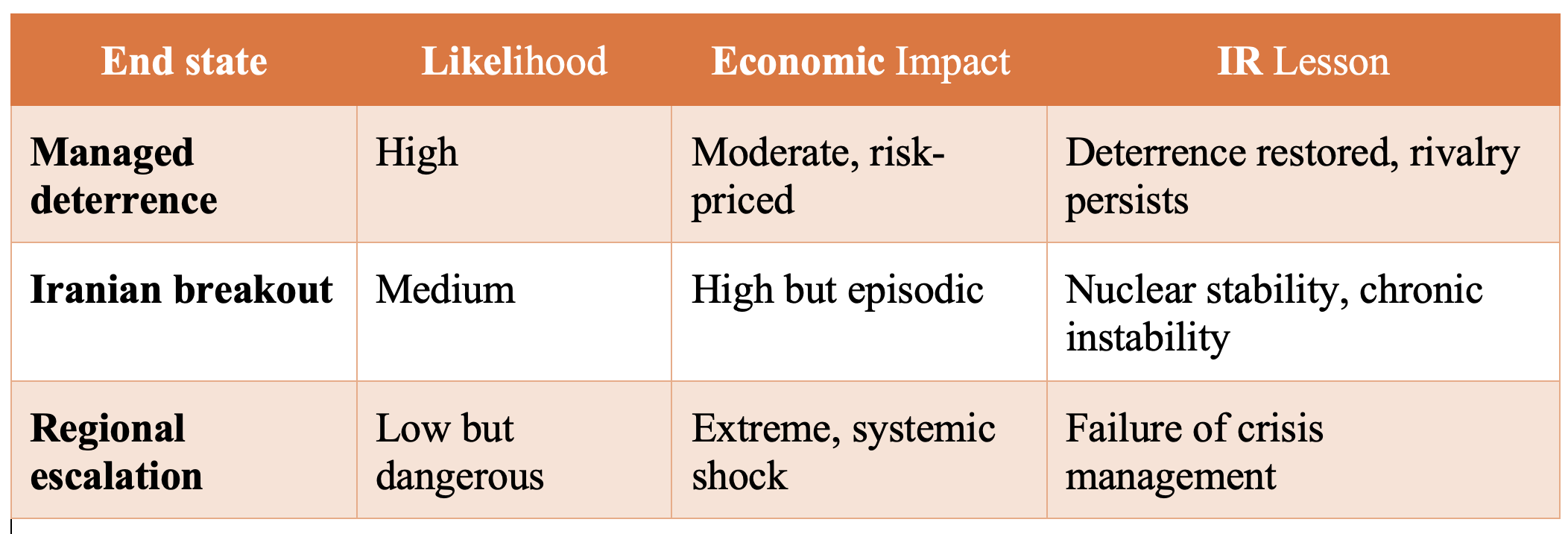
All three outcomes are shaped by the same interaction of forces explored across this series: the security dilemma, asymmetric denial, and the ceiling imposed by nuclear risk.
The decisive contest is over the meaning of disruption
This brings us to the strategic core of the matter.
The decisive contest is not simply over ships, missiles or even sea lanes. It is over the meaning of disruption.
Iran seeks to disrupt the maritime domain to signal Western vulnerability, the fragility of the regional order, and the enduring relevance of Iranian leverage. The United States and Israel want the same disruption to appear manageable, containable, and ultimately incapable of changing the larger balance.
That is why the financial dimension matters so much. As argued in Part II, the real arbiters of strategic effect in Hormuz are often not Presidents or Generals but insurers, reinsurers, charterers and shipowners responding to risk signals. For trading states, including India, the practical outcome is measured less by territorial shifts than by freight rates, risk premiums, routing decisions, and access to cover.
In this war, the decisive question is not who wins the naval battle, but which equilibrium the region settles into afterwards, and whether the meaning of maritime disruption is defined in Tehran, in Washington, or in the markets that decide if ships sail at all.
That, finally, is the logic that links all three parts of this series.
Part I argued that the conflict is driven by a security–insecurity spiral, in which defensive moves deepen mutual fear.
Part II showed how that spiral manifests at sea as a contest between sea-control and sea-denial navies, with Hormuz acting as both pressure valve and hidden financial battlespace.
Part III has asked what victory means under such conditions, how escalation is structured, and which end states are most plausible.
Put differently, the series has moved from cause, to arena, to outcome.
The cause is the spiral of insecurity. The arena is Hormuz and the wider maritime–economic battlespace. The outcome will depend on which theory of victory proves politically sustainable—and which equilibrium the region is ultimately forced to accept.
The question, especially for India, is what each of these end states implies for energy security, maritime posture, and dependence on foreign risk-capital systems that can price strategic access without firing a shot.